
The Doomsday Fish: Why the Ocean’s Scariest Sea Serpent is Just a Terrible Swimmer
he giant oarfish has been blamed for predicting earthquakes and tsunamis for centuries. But massive scientific studies have proven there is zero link between the fish and seismic activity.

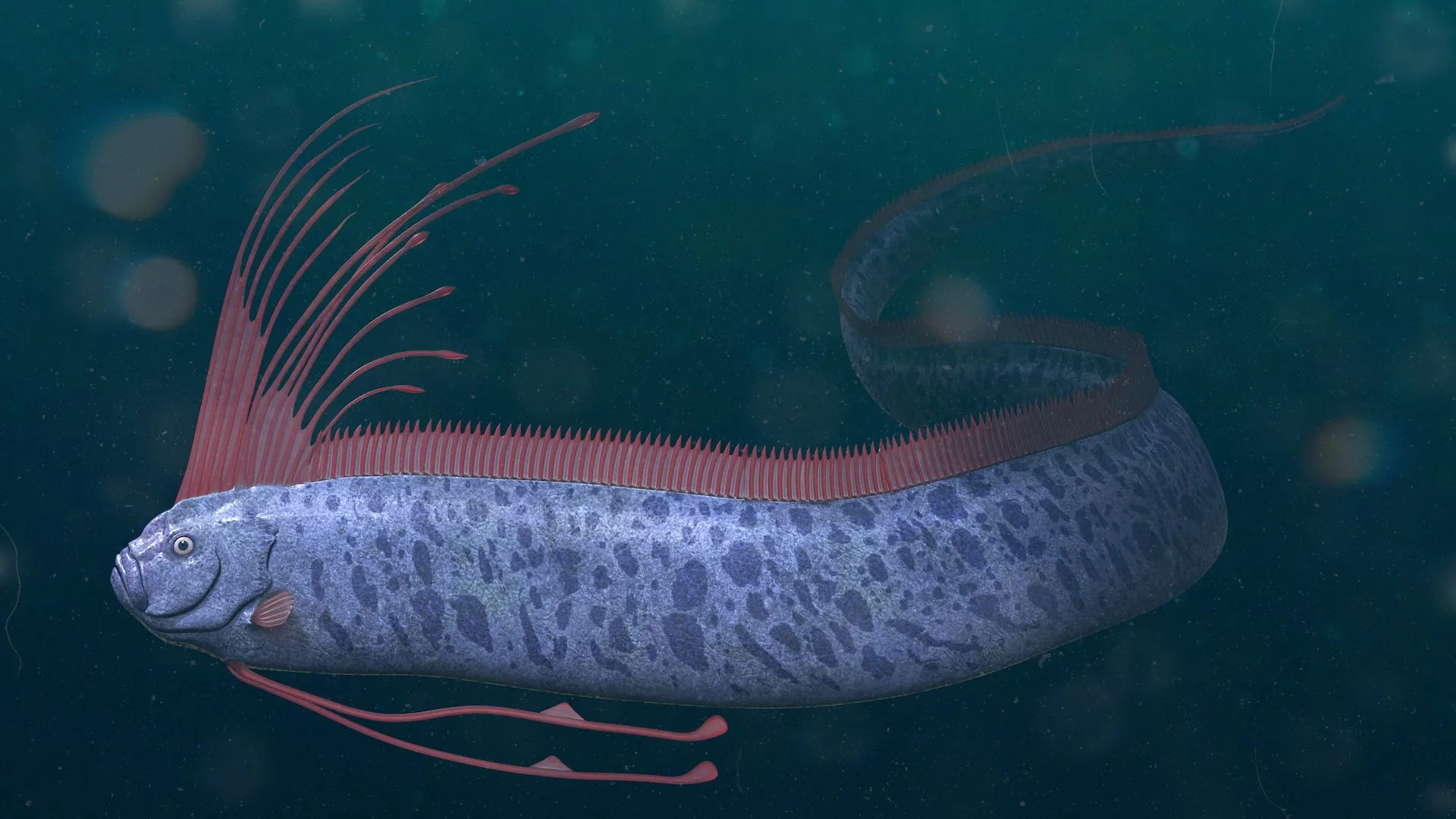
To understand how a fish became the ultimate harbinger of doom, we have to look at ancient Japanese folklore and the human brain’s desperation to find patterns where none exist.
The Messenger from the Sea God
The creature in question is the Giant Oarfish (Regalecus glesne). It is the longest bony fish in the world, capable of growing up to a staggering 11 metres (36 feet) long. Because they live entirely in the mesopelagic zone (the pitch-black “twilight zone” of the deep ocean), humans almost never see them alive.
Historically, when one of these massive, terrifying ribbons of silver and red washed ashore, people understandably thought it was a literal sea serpent.
In Japanese mythology, the oarfish is known as Ryugu no Tsukai, which translates to the “Messenger from the Sea God’s Palace.” The legend dictates that the oarfish purposely swims to the surface to warn humans that a massive earthquake or tsunami is about to strike.
This myth went into overdrive in 2010 and 2011. A highly unusual number of oarfish washed up on the shores of Japan, and shortly after, the devastating 2011 Fukushima earthquake and tsunami occurred. The internet connected the two events, and the “Doomsday Fish” legend became a permanent, modern viral fact.
The 2019 Scientific Takedown
The legend became so widely accepted that seismologists actually had to step in. Scientists genuinely wanted to know: could a deep-sea fish feel the tectonic plates shifting before our multimillion-pound sensors could?
In 2019, a team of researchers from Tokai University in Japan decided to settle the debate once and for all. They gathered every single recorded instance of deep-sea fish washing ashore in Japan between 1928 and 2011 (a total of 336 fish sightings). Then, they cross-referenced those dates with the records of 221 major earthquakes that occurred over that exact same 83-year period.
The results were completely underwhelming.
Out of the 336 deep-sea fish appearances, only one single event occurred within 30 days and 100 kilometres of a major earthquake. It was a statistical flatline. The 2011 oarfish strandings were just a tragic, coincidental fluke of timing. The researchers conclusively proved that the oarfish has absolutely no predictive connection to earthquakes.
The Boring Biological Truth
If they are not fleeing from shifting tectonic plates, why do these deep-sea monsters occasionally wash up on our beaches?
Because the giant oarfish is a fundamentally rubbish swimmer.
Despite their massive, dragon-like appearance, they have very little muscle mass. In the calm, still waters of the deep ocean, they just hover vertically in the water column, catching tiny plankton. But if a strong storm, a shift in ocean temperature, or a weird seasonal current (like El Niño) catches them, they are completely powerless to fight it.
The oarfish gets swept up out of the deep sea and dragged into the turbulent, shallow coastal waters. By the time it reaches the beach, it is not delivering a message from the Sea God. It is just exhausted, disoriented, or already dead from the temperature shock.
TL;DR
The giant oarfish does not predict natural disasters. The idea that this 36-foot “Doomsday Fish” warns humanity of earthquakes comes from ancient Japanese folklore (Ryugu no Tsukai) and a coincidental stranding event before the 2011 Fukushima earthquake. However, a massive 2019 scientific study cross-referenced 83 years of oarfish sightings with earthquake data and found zero statistical correlation. The boring biological truth is that oarfish are incredibly weak swimmers; they only wash ashore when they are sick, dying, or accidentally dragged to the surface by strong ocean currents and storms.
Further Reading
GeoScienceWorld (Bulletin of the Seismological Society of America) — “Is Japanese Folklore Concerning Deep‐Sea Fish Appearance a Real Precursor of Earthquakes?” The original 2019 peer-reviewed study that finally debunked the centuries-old Doomsday Fish myth with cold, hard statistics.
🔗 https://pubs.geoscienceworld.org/bssa/article-abstract/109/4/1556/571665/Is-Japanese-Folklore-Concerning-Deep-Sea-Fish
Closing Thought
The next time a viral post warns you that a dead oarfish on a beach means the apocalypse is imminent, you do not need to pack an emergency bag. The only tragedy occurring is that a giant, majestic deep-sea noodle got lost in a current and ended up in the wrong postcode.