Scientists Spent Decades Believing Woodpeckers' Tongues Protected Their Brains (They Were Spectacularly Wrong)
The truth about how woodpeckers avoid concussions is both simpler and more remarkable than anyone thought

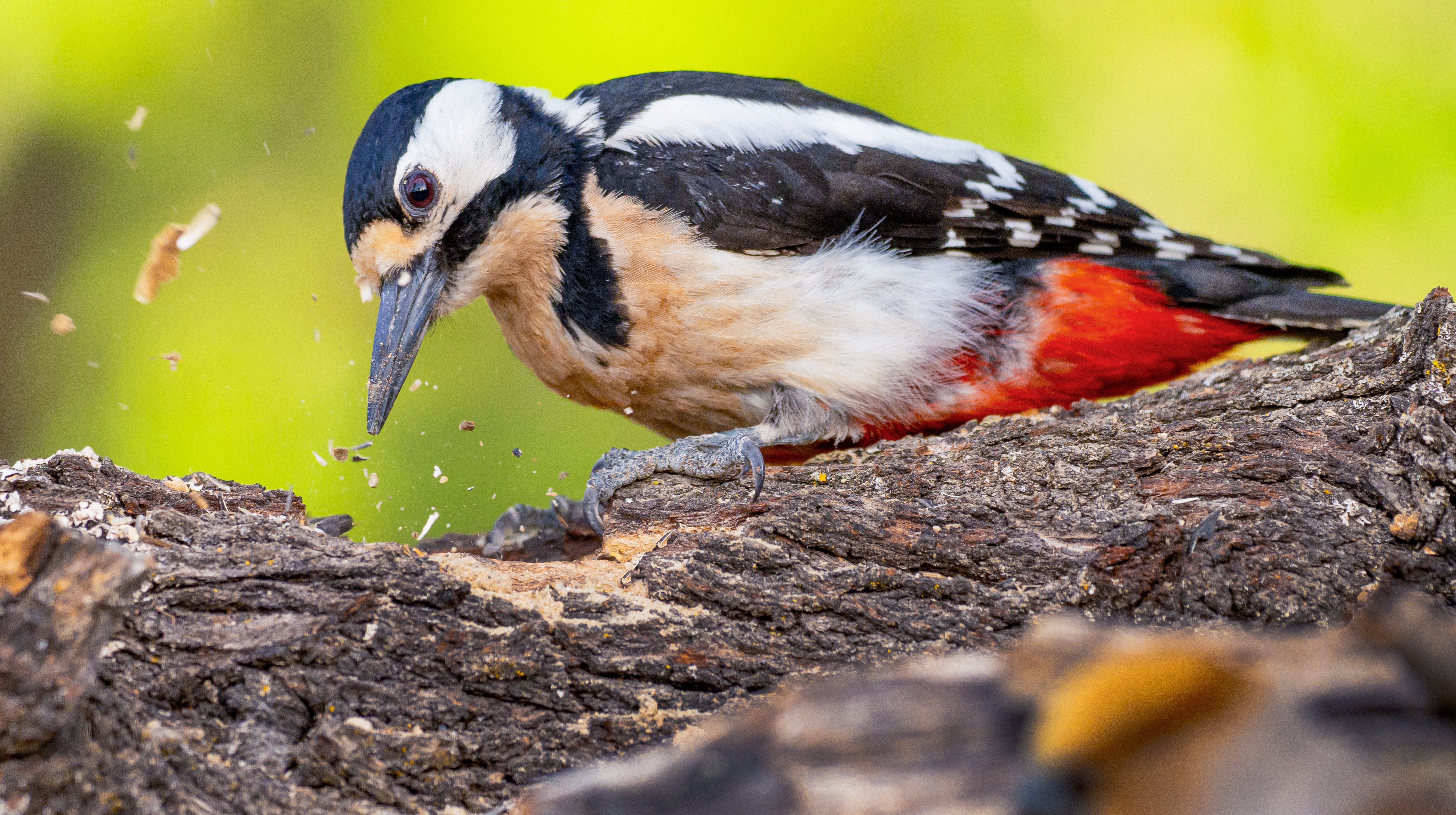
For decades, scientists, textbook authors, and zoo information plaques have confidently explained how woodpeckers avoid brain damage whilst hammering their heads against trees up to 20 times per second. The answer seemed obvious: these remarkable birds must have evolved sophisticated shock-absorbing mechanisms… spongy skull bones, cushioning beaks, or most famously, extraordinarily long tongues that wrap around their brains like biological seatbelts.
It was a compelling theory that inspired engineers to design football helmets and shock-absorbing materials based on woodpecker anatomy. There was just one problem: it was completely wrong.
In 2022, a team of researchers armed with high-speed cameras and a healthy dose of scientific scepticism demolished decades of accepted wisdom about woodpecker brain protection. Their findings revealed that everything we thought we knew about these birds was backwards, and the real explanation is far more elegant than anyone imagined.
The Myth That Fooled Everyone
The woodpecker tongue story sounds perfectly plausible. These birds do indeed have extraordinarily long tongues, up to three times the length of their beaks in some species. The tongue originates in the bird's nostrils, splits into two parts, wraps completely around the skull, and reunites at the base of the beak. It's a genuinely bizarre anatomical arrangement that suggests nature has gone to considerable trouble to protect something precious.
When the muscles surrounding this complex structure contract, they were thought to create a sort of biological crash helmet, holding the skull and spine rigidly in place during impact. The theory made intuitive sense: if you're going to ram your head into solid wood thousands of times per day, you'd better have some serious protection.
The problem, as researcher Sam Van Wassenbergh from the University of Antwerp discovered, is that intuitive explanations in biology are often completely wrong.
The Hammer That Thinks It's a Hammer
Van Wassenbergh and his team visited four European zoos equipped with high-speed cameras capable of capturing woodpecker pecks at thousands of frames per second. What they saw when they slowed down the footage was shocking in its simplicity: woodpecker heads behave exactly like rigid hammers.
"The way we see the head behaving is very rigid, like you would use a hammer hitting wood," Van Wassenbergh explains. The beak and skull stop moving at exactly the same time upon impact, with no compression, cushioning, or shock absorption whatsoever. If the tongue or skull were providing protection, the brain would decelerate more slowly than the beak. Instead, everything stops dead simultaneously.
This means that with every peck, a woodpecker's brain experiences deceleration forces that would cause instant concussion in humans. Some species generate impacts of 1,200 to 1,400 G-forces, roughly ten times what would knock out a human. Yet they emerge completely unscathed.
The Evolutionary Logic of Rigid Skulls
Once you think about it, the shock-absorbing skull theory never made much sense from an evolutionary perspective. As Van Wassenbergh points out, "People don't use hammers that have a shock absorber built into it; it just makes hammering quite inefficient."
Woodpeckers need maximum impact force to drill through solid wood in search of insects or to excavate nesting cavities. Any energy absorbed by cushioning systems would be energy not transferred to the wood, making these birds less effective at their primary survival strategy. Evolution doesn't favour animals that are worse at finding food or building homes.
The research team tested this hypothesis using computer models. They found that if woodpeckers had shock-absorbing mechanisms, they would need to strike much harder to achieve the same drilling results, requiring significantly more energy and making them less competitive.
The Real Secret: Physics Favours the Small
So how do woodpeckers avoid brain damage whilst essentially using their heads as biological jackhammers? The answer lies in a fundamental principle of physics that most people never consider: smaller objects can withstand much higher forces relative to their size.
"We forget that woodpeckers are considerably smaller than humans," Van Wassenbergh notes. "Smaller animals can withstand higher decelerations. Think about a fly that hits a window and then just flies back again."
A woodpecker's brain is approximately 700 times smaller than a human brain. This dramatic size difference means that even the most violent pecking generates less than 60% of the pressure needed to cause concussion in humans. The birds are operating well within their safety margins, despite appearances.
The Tongue's True Purpose
This doesn't mean woodpecker tongues are useless… quite the opposite. These remarkable appendages serve several crucial functions that have nothing to do with brain protection.
First, they're essential feeding tools. Woodpecker tongues are covered with backward-facing barbs and sticky saliva, perfect for extracting insects from deep crevices in bark or wood. Some species use them to lap up sap or even to spear insects like tiny biological harpoons.
The muscles surrounding the hyoid bone (the structure supporting the tongue) do contract during pecking, but rather than cushioning blows, they help coordinate the complex biomechanics of drilling whilst keeping the tongue safely retracted during impact.
The Engineering Implications
The revelation that woodpeckers succeed through rigid efficiency rather than sophisticated cushioning has significant implications for human engineering. Decades of research into shock-absorbing helmets and protective equipment based on woodpecker anatomy may have been pursuing the wrong approach entirely.
Instead of trying to absorb impact energy, perhaps protective equipment should focus on distributing forces more efficiently or operating within different size and mass parameters. The woodpecker model suggests that sometimes the best protection is not protection at all, but rather operating within physical limits that don't require protection.
Other Remarkable Adaptations
Whilst the tongue-cushion theory proved false, woodpeckers do possess numerous other extraordinary adaptations for their high-impact lifestyle:
They close their eyes milliseconds before impact to protect them from flying debris. Their beaks have a clever two-part design that allows them to break free when they become stuck in wood. Their tail feathers are reinforced and pointed to provide additional support against tree trunks. Their feet are zygodactyl (two toes facing forward, two backward) for optimal gripping.
Perhaps most remarkably, they can adjust their pecking technique for different purposes, gentle tapping for communication, moderate force for foraging, and maximum impact for excavation.
The Lesson in Scientific Humility
The woodpecker story illustrates how even well-established scientific explanations can persist for decades without proper testing. The shock-absorption theory was repeated in textbooks, taught in universities, and explained to children at zoos… all without anyone actually measuring what happens during pecking.
"This myth of shock absorption in woodpeckers is now busted by our findings," Van Wassenbergh states bluntly. "While filming the woodpeckers in zoos, I have witnessed parents explaining to their kids that woodpeckers don't get headaches because they have a shock absorber built into their head."
The research demonstrates the importance of testing assumptions, however logical they may seem. Sometimes the most obvious explanation is also the most wrong.
The Beauty of Simple Solutions
In the end, the real secret of woodpecker survival isn't exotic anatomy or complex protective mechanisms, it's elegant simplicity. These birds succeed because they're small enough to operate within physical limits that make protection unnecessary, and efficient enough to maximise the energy transfer needed for their lifestyle.
Their brains are safe not because they're cushioned, but because they're small. Their skulls work not because they absorb shock, but because they don't. Their survival strategy isn't about withstanding impact, it's about being built to scales where extreme impacts aren't dangerous.
It's a reminder that nature often achieves remarkable results through simple physics rather than complex engineering. Sometimes the most extraordinary adaptation is simply being the right size for your ecological niche.
The woodpecker's true superpower isn't its protective equipment, it's its proof that when you're built to the right scale, you don't need protection at all.
TL;DR:
Scientists long believed woodpecker tongues wrapped around their brains for protection, inspiring helmet designs and textbook explanations. New high-speed video research shows woodpecker heads act like rigid hammers with no shock absorption. They avoid brain damage because their brains are 700 times smaller than humans'… size, not cushioning, provides protection.
Further Reading:
Van Wassenbergh study debunking shock absorption: https://www.science.org/content/article/contrary-popular-belief-woodpeckers-don-t-protect-their-brains-when-headbanging-trees
NPR coverage of the research: https://www.npr.org/2022/07/14/1110581385/a-woodpeckers-brain-takes-a-big-hit-with-every-peck-study
Woodpecker anatomy and adaptations: https://abcbirds.org/blog21/woodpecker-tongues/
So there you have it: one of biology's most charming explanations turned out to be completely backwards. Woodpeckers don't need elaborate protection because they're operating at a scale where extreme forces aren't extreme at all. It's physics masquerading as physiology, and it's far more elegant than any shock absorber could ever be.
If you enjoyed learning how decades of scientific certainty can be overturned by actually looking at what animals do rather than assuming what they must do, you'll love The Useless Genius newsletter. We specialise in discovering how the most obvious explanations in science are often spectacularly wrong, perfect for those moments when someone confidently explains something that sounds perfectly logical but happens to be complete nonsense.